import requests

# Identify yourself. The next section explains why this header matters; Wikipedia refuses anonymous library defaults with a 403.
HEADERS = {
    "User-Agent": "WebDataScience/1.0 (INFO 4617; your-email@colorado.edu)"
}

# Retrieve robots.txt for Wikipedia
response = requests.get("https://en.wikipedia.org/robots.txt",
                        headers=HEADERS)
print(response.text[:500])
# The generic rules (as of mid-2026) include directives like:
# User-agent: *
# Allow: /w/api.php?action=mobileview&
# Allow: /w/load.php?
# Disallow: /w/
# Disallow: /api/
# Disallow: /wiki/Special:2 Ethics, Law, and Responsible Data Collection
TipLearning Objectives
- Explain the legal frameworks governing web data access, including the CFAA, GDPR, and platform Terms of Service
- Retrieve and interpret a website’s
robots.txtfile to determine what is permitted for automated access - Configure responsible HTTP request headers including custom User-Agent strings with contact information
- Apply a structured ethical decision framework before collecting web data
- Implement rate limiting with
time.sleep()to avoid overloading servers
TipCompanion Notebook
Run this chapter’s code as you read: open the companion notebook (see Appendix A for all of them).
2.1 The Ethics of Retrieval
The phrase “web scraping” is colloquial and popular but has pejorative connotations. Data is valuable: other people invested time, money, and effort to create and host the content you are about to retrieve programmatically. Before writing a single line of scraping code, you need to understand the law, the norms, and the ethics that govern your work.
This chapter establishes a decision framework that you should revisit before every data collection project in this book and beyond. The question “can I scrape this?” always carries two more behind it: “should I, and if so, how do I do it responsibly?”
2.2 Legal Frameworks
2.2.1 The Computer Fraud and Abuse Act
The Computer Fraud and Abuse Act (CFAA) was enacted in 1986, expanding a narrower 1984 predecessor statute, in response to growing concerns about computer crime. Its key provision prohibits “unauthorized access” to computer systems, but what counts as “unauthorized” in the context of web scraping has been a matter of ongoing litigation.
Two cases define the modern boundaries. In Van Buren v. United States (2021), the Supreme Court narrowed the CFAA’s “exceeds authorized access” provision: the Court adopted a “gates-up-or-down” reading under which the statute targets accessing systems or areas of systems you are not entitled to enter — not misusing information you were allowed to see. Before Van Buren, violating a website’s stated terms could plausibly be framed as a federal crime; after it, that theory is much harder to sustain.
The second is hiQ Labs v. LinkedIn. hiQ, a data analytics company, scraped public LinkedIn profiles to build workforce analytics products; LinkedIn sent a cease-and-desist letter and blocked hiQ’s access. The Ninth Circuit held in 2019 — and, after the Supreme Court sent the case back for reconsideration in light of Van Buren, held again in 2022 — that scraping publicly accessible data likely does not violate the CFAA, since no authentication “gate” was bypassed. But that is not the end of the story: later in 2022, hiQ lost on LinkedIn’s breach-of-contract claim — it had continued scraping after agreeing to the Terms of Service and receiving the cease-and-desist — and the case settled with hiQ agreeing to stop. The CFAA probably does not criminalize scraping public pages; contract law can still make it costly.
The case of Sandvig v. Barr challenged the CFAA’s application to researchers who violated a website’s Terms of Service in order to conduct audit studies of algorithmic discrimination. In 2020, a federal district court held that merely violating Terms of Service does not constitute a CFAA crime — a meaningful, if limited, protection for research. The case illustrates the tension between researchers’ need for data and platforms’ desire to control how their systems are studied.
The legal terrain is unsettled and varies by jurisdiction. “It’s technically possible” is not the same as “it’s legal,” and “it’s legal” is not the same as “it’s ethical.”
2.2.2 The Current Landscape: Scraping, AI, and State Privacy Law
The legal terrain has kept shifting since these landmark cases, and as of mid-2026 three developments matter most for your work.
First, courts have continued to treat scraping of public, logged-out content skeptically as a target for platform lawsuits. In early 2024, Meta’s breach-of-contract claims against the data broker Bright Data failed in federal court because the scraping at issue collected only publicly available data without logging in; a parallel suit by X Corp. against the same company was dismissed later that year, with the court warning against letting platforms use contract law to claim exclusive ownership of public web data. These are trial-court rulings, not nationwide rules — but the direction is consistent with hiQ: authentication barriers and contractual relationships, not public visibility, are where legal risk concentrates. A scraper that logs in to your own account puts you on the contract side of that line: Chapter 8 (“Pages Behind a Login”) shows how a browser your code drives can log in, and works through what that costs.
Second, generative AI has opened a new front. The New York Times v. OpenAI and Microsoft (filed 2023) and a wave of similar suits ask whether scraping copyrighted content to train AI models is infringement or fair use. Whatever the outcomes, the litigation has already changed the web: publishers have hardened their sites against crawlers, added AI-specific directives to robots.txt, and signed exclusive licensing deals — enclosure dynamics you will recognize from Chapter 3.
Third, U.S. states have filled part of the federal privacy vacuum. California’s CCPA/CPRA came first, and by 2026 more than a dozen states — including Colorado, whose Colorado Privacy Act applies to data about Colorado residents — have comprehensive privacy statutes with GDPR-like concepts: personal data rights, purpose limitation, and obligations on data processors. If your scraped dataset contains personal information about residents of these states, these laws can apply to you even as a student researcher. The practical implication is the same one this chapter keeps returning to: collect the minimum you need, and treat personal data as a liability, not an asset.
2.2.3 Terms of Service as Quasi-Law
Every major platform has Terms of Service (ToS) that restrict automated data collection. When you create an account on Twitter, Reddit, or Facebook, you agree to these terms. Violating them can result in account suspension, IP blocking, or even legal action.
WarningWarning
The code in several chapters of this book will retrieve data in ways that may violate the Terms of Service of the platforms involved. This is done in an educational context to teach technical skills. You are responsible for understanding and abiding by the terms of any platform you access. When in doubt, do not scrape — use an official API or request access through an institutional research program.
2.2.4 International Considerations
The European Union’s General Data Protection Regulation (GDPR) adds another layer of complexity. GDPR gives individuals the right to control how their personal data is collected and processed. If you are scraping data that includes personally identifiable information about EU residents — names, email addresses, social media handles — you may be subject to GDPR requirements regardless of where you are located.
2.3 Technical Norms: robots.txt
Beyond legal requirements, the web has developed a set of community norms for responsible automated access. The most important of these is the robots.txt protocol.
A robots.txt file lives at the root of a website (e.g., https://example.com/robots.txt) and specifies which parts of the site automated agents are permitted or forbidden from accessing. It uses a simple syntax:
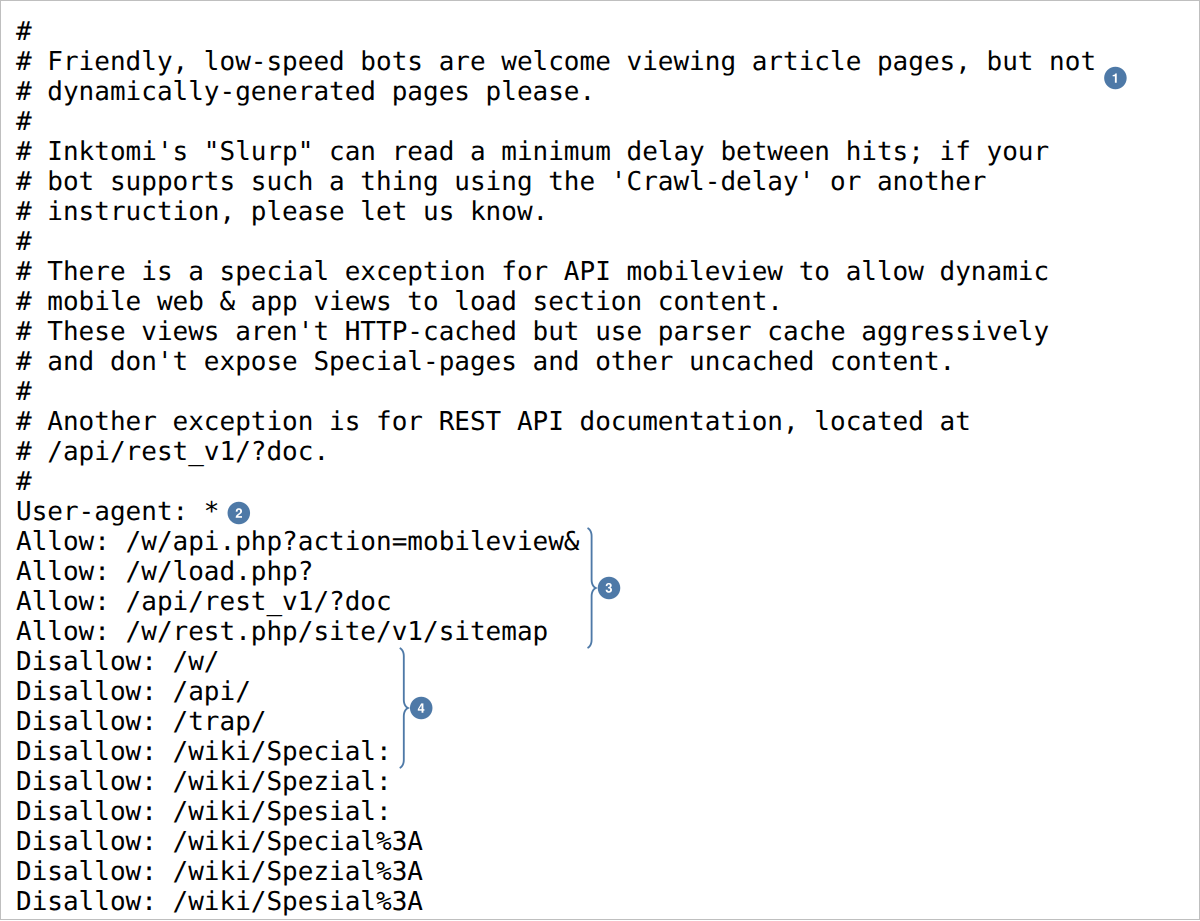
User-agent: * ② starts the rules for all crawlers: four Allow exceptions ③, then Disallow rules for /w/, /api/, /trap/, and /wiki/Special: ④, followed by the same rule in other languages’ spellings.
The key directives are User-agent (which crawler the rule applies to), Disallow (paths that should not be accessed), Allow (exceptions to disallow rules), and Crawl-delay (requested time between requests); Figure 2.1 shows the first three in Wikipedia’s file. You can parse these programmatically:
from urllib.robotparser import RobotFileParser

# Raise and exception if the site sends back a 403/4
response.raise_for_status()

# Hand the parser text you fetched yourself, rather than calling rp.read(). The callout below explains what rp.read() does instead.
rp = RobotFileParser()
rp.parse(response.text.splitlines())

# Can a generic crawler fetch an encyclopedia article?
print(rp.can_fetch("*", "https://en.wikipedia.org/wiki/Python_(programming_language)"))
# True — article pages under /wiki/ are open to crawlers

# Can it fetch the dynamic pages under /w/, including the API?
print(rp.can_fetch("*", "https://en.wikipedia.org/w/api.php"))
# False — /w/ is disallowed for crawlers, with only narrow exceptions

# Can it fetch special/internal pages?
print(rp.can_fetch("*", "https://en.wikipedia.org/wiki/Special:Search"))
# False — Special: pages are disallowed
WarningWhy not
rp.read()?
RobotFileParser has a read() method that fetches the file for you, and almost every tutorial uses it. Do not. It fetches through urllib, whose default User-Agent is Python-urllib/3.x, and Wikipedia answers that with 403 Forbidden.
The failure is silent. Here is the relevant part of the standard library:
A 403 is quietly recorded as “this site disallows everything.” Nothing raises. Every can_fetch() call then returns False, and you conclude that Wikipedia bans crawlers — the opposite of what its robots.txt actually says. requests has the same problem for the same reason: its default python-requests/2.x is refused too.
So fetch the file yourself with a User-Agent that identifies you, then pass the text to rp.parse(). The library that reads the politeness file is impolite by default, which is a fair summary of why this chapter exists.
The second result deserves a pause, because it teaches an important nuance. Wikipedia wants programmatic users on its API — Chapter 10 is built on it — yet robots.txt disallows /w/ paths. The two facts are not in conflict: robots.txt addresses crawlers that discover and fetch pages by following links, and Wikipedia would rather crawlers index its stable article URLs than its infinite space of dynamic, server-intensive /w/ URLs. Deliberate API clients are governed by a different set of norms — the Wikimedia User-Agent policy and API etiquette guidelines — that you will follow in Chapter 10. The general lesson: robots.txt tells you how a site wants automated page-fetching to behave, and it is one input among several (Terms of Service, API documentation, rate-limit guidance) rather than the complete rulebook.
If a site declares a Crawl-delay, you can read it programmatically and respect it:
Two important caveats. First, robots.txt is a norm, not a law. Violating it is not illegal (in most jurisdictions), but it is disrespectful of the site operator’s wishes and may result in your IP being blocked. Second, if a site does not have a robots.txt file (the request returns a 404), that means there are no crawling restrictions — not that you should crawl aggressively.
2.3.1 Comparing robots.txt Across Platforms
Different organizations have dramatically different approaches to automated access, and their robots.txt files reveal these philosophies. Compare three major sites:
import requests

sites = {
    "Wikipedia": "https://en.wikipedia.org/robots.txt",
    "Reddit": "https://www.reddit.com/robots.txt",
    "NY Times": "https://www.nytimes.com/robots.txt",
}

for name, url in sites.items():
    response = requests.get(url, headers=HEADERS)   # same header as above
    lines = response.text.strip().split("\n")
    disallow_count = sum(1 for line in lines if line.startswith("Disallow"))
    allow_count = sum(1 for line in lines if line.startswith("Allow"))
    print(f"{name}: {len(lines)} lines, {disallow_count} Disallow rules, {allow_count} Allow rules")
# Wikipedia: 712 lines, 460 Disallow rules, 4 Allow rules
# Reddit: 8 lines, 1 Disallow rules, 0 Allow rules
# NY Times: 359 lines, 149 Disallow rules, 27 Allow rules
Wikipedia’s robots.txt is permissive where it matters most — the encyclopedia articles under /wiki/ are open to crawlers — while restricting dynamic pages, editing interfaces, and internal administration paths under /w/ and Special:. Programmatic access to its data happens instead through the API and public database dumps, governed by their own etiquette policies. This division of labor reflects Wikipedia’s organizational commitment to openness: the data exists to be shared, through channels designed for sharing it. The New York Times restricts selectively, blocking large sections of the site while leaving others open — reflecting the fact that its content is a commercial product.
Reddit is the interesting case, and the shortest file. It is eight lines: a comment block, then User-agent: * followed by Disallow: /. Every crawler, every path, denied. The comments point instead to Reddit’s Public Content Policy and to a separate program for researchers. Reddit spent years as one of the most openly scrapable large platforms; the blanket denial is recent, and it arrived with the AI-licensing deals described in Chapter 3.
Length is not restrictiveness. Wikipedia’s 700 lines and 460 Disallow rules describe a site that mostly wants to be crawled, carefully. Reddit’s two rules close it completely.
These differences reflect each organization’s relationship with automated access: Wikipedia encourages it as part of its mission, Reddit tolerates it within limits, and the Times treats its content as proprietary. Reading robots.txt before you scrape tells you not just what is permitted but what kind of organization you are dealing with.
2.4 Responsible Request Headers
When your code makes requests to a web server, the server sees metadata about the request, including the User-Agent header, which identifies who is making the request. By default, the requests library sends a generic User-Agent string: python-requests/ and a version number. Wikimedia’s User-Agent policy (Figure 2.2) asks every automated client for more: a name, a version, and a way to contact whoever runs it.
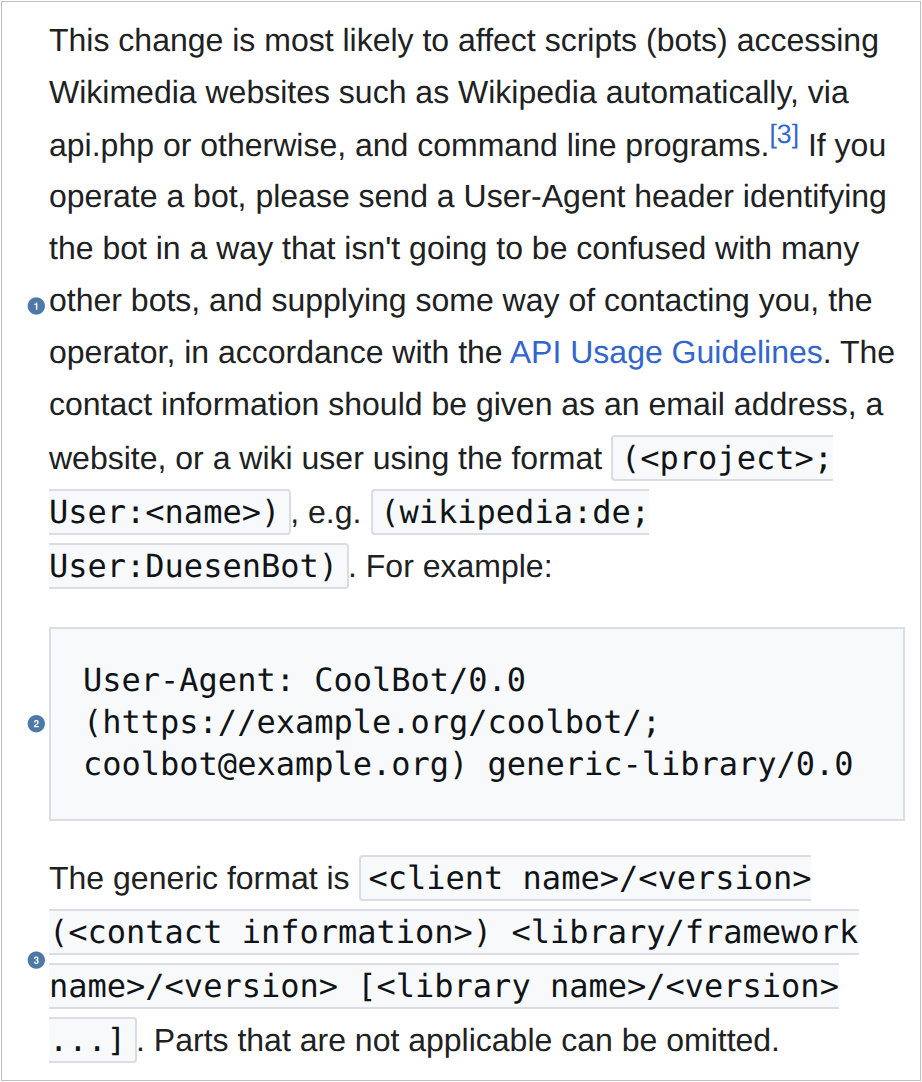
<client name>/<version> (<contact information>) ③, as this book’s WebDataScience/1.0 (your-email@colorado.edu) does.
Replace the default with a User-Agent that identifies you and provides contact information:
This practice serves two purposes: it lets site operators contact you if your scraping causes problems, and it signals that you are a responsible actor rather than a malicious bot. Some APIs (including the Wikimedia API you used in Chapter 1) require a meaningful User-Agent and will return errors or impose stricter rate limits if you do not provide one.
TipMissing Manual Reference
For a deeper introduction to HTTP requests, headers, and status codes — the machinery beneath every example in this chapter — see Missing Manual Chapter 24: HTTP and Web APIs.
2.5 Rate Limiting
Making hundreds of requests per second to a web server can degrade its performance for other users — effectively mounting a denial-of-service attack on a site you are trying to study. Always space out your requests:
A good default is one request per second. If the site’s robots.txt specifies a Crawl-delay, respect it. If you are hitting an API with documented rate limits, stay well within them.
2.5.1 Building a Responsible Scraper Function
The principles above — custom User-Agent, rate limiting, error handling — appear in every scraping project. Rather than implementing them ad hoc each time, you can wrap them into a reusable function:
import requests
import time
import logging

def responsible_get(url, headers=None, delay=1.0):
    """Make an HTTP GET request with responsible defaults.

    Parameters
    ----------
    url : str
        The URL to request
    headers : dict, optional
        Custom headers; a default User-Agent is added if none provided
    delay : float
        Seconds to wait after the request (default: 1.0)

    Returns
    -------
    requests.Response or None
        The response object, or None if the request failed
    """
    default_headers = {
        "User-Agent": "WebDataScience/1.0 (student-project; your-email@colorado.edu)"
    }
    if headers:
        default_headers.update(headers)

    try:
        response = requests.get(url, headers=default_headers, timeout=30)
        response.raise_for_status()  # Treat 4xx/5xx statuses as failures
        logging.info(f"{response.status_code} {url}")
        time.sleep(delay)
        return response
    except requests.exceptions.HTTPError as e:
        logging.error(f"HTTP error: {e}")
        time.sleep(delay)  # A failed request still counts against the server
        return None
    except requests.exceptions.RequestException as e:
        logging.error(f"Request failed ({type(e).__name__}): {url}")
        return None
Every design choice in this function reflects a principle from this chapter. The default User-Agent identifies you and provides contact information, so site operators can reach you if your scraping causes problems. The configurable delay enforces rate limiting by default — you have to explicitly override it, which makes aggressive scraping a conscious decision rather than an oversight. The raise_for_status() call ensures that a 404 Not Found or 403 Forbidden is treated as the failure it is, rather than silently passed downstream to your parser. The except blocks handle both HTTP errors and the whole family of network failures (ConnectionError, Timeout, SSLError, and other RequestException subtypes) gracefully, logging the error instead of crashing your entire scraping run. The timeout parameter prevents your script from hanging indefinitely on an unresponsive server. And if a site declares a Crawl-delay in its robots.txt, pass that value as delay so your tool honors the site’s own stated preference.
You will use variations of this pattern in Chapter 6 when scraping HTML tables, in Chapter 7 when retrieving historical snapshots, and throughout the API chapters. Building responsible defaults into your tools is more reliable than remembering to add them each time.
2.6 An Ethical Decision Framework
Before any data collection project, work through these five questions:
Legality. Is this data collection permitted under the CFAA, GDPR, and any applicable local laws? Is it consistent with the site’s Terms of Service?
Consent. Did the people whose data you are collecting consent to this use? Is the data truly public, or did users share it within a platform with reasonable expectations of limited visibility?
Proportionality. Are you collecting only the data you need for your research question? Could you answer your question with less data or with less sensitive data?
Privacy. Does your dataset contain personally identifiable information? Could individuals be re-identified from ostensibly anonymized data? What are the risks if the data is breached or misused?
Server impact. Will your scraping impose a meaningful load on the server? Are you rate-limiting appropriately? Are you scraping during off-peak hours for high-traffic sites?
No framework can substitute for judgment. But working through these questions systematically will help you identify risks and make defensible decisions.
2.6.1 IRBs and Web Data
If you are conducting research at a university, there is an additional layer of oversight: the Institutional Review Board (IRB). IRBs review research involving human subjects to ensure it meets ethical standards derived from the Belmont Report’s three principles — respect for persons, beneficence, and justice.
When does web scraping become human subjects research? The general rule is that it qualifies when you collect data about identifiable people to produce generalizable knowledge. Scraping public government records — legislative votes, budget documents, meeting minutes — is usually not human subjects research because the subjects are institutions and public officials acting in their official capacities. But scraping social media profiles to study health behaviors, political attitudes, or personal relationships almost certainly is, because you are studying identifiable individuals and their behavior.
The line is not always clear. Scraping aggregated, anonymous data (like Wikipedia edit counts without usernames) falls into a gray area. Data you can see only after logging in, such as a members-only forum or posts shared with friends, is not publicly available in this sense, even though your account can see it (Chapter 8). When in doubt, consult your institution’s IRB. Many universities have expedited review processes for minimal-risk research involving publicly available data, and the process of writing an IRB protocol forces you to think carefully about privacy, consent, and data security — exactly the issues this chapter’s framework addresses. The Belmont Report’s principles complement the five-question framework above: respect for persons maps to consent, beneficence to proportionality and privacy, and justice to the question of who bears the risks and who receives the benefits of your research.
2.7 Recommended Exercises
This guided exercise is the chapter’s take-home assignment. Work through it in the companion notebook, filling in each empty code cell, and submit the completed notebook. The steps build on one another, so do them in order — everything you need appears in this chapter or in Chapter 1.
You will audit how three websites govern automated access, using the tools this chapter introduced: a named User-Agent, robots.txt, RobotFileParser, and polite request pacing.
Step 1 — Identify yourself. Define a HEADERS dictionary with a User-Agent string that names this course and includes your email, following the chapter’s pattern. You will send it with every request in this exercise.
Step 2 — Fetch a robots.txt. Retrieve https://en.wikipedia.org/robots.txt with your headers. Print the status code and the first 500 characters, as you printed a response body in Chapter 1.
Step 3 — Parse it properly. Create a RobotFileParser, feed it the text you fetched with rp.parse(text.splitlines()) — not rp.read(), for the reason the chapter explains — and test can_fetch("*", ...) on three URLs: an article under /wiki/, something under /w/, and a Special: page. Print all three results.
Step 4 — Widen the comparison. Pick two more websites you actually use. Fetch each site’s robots.txt politely — with your headers and time.sleep(1) between requests — and for each file count total lines, Disallow rules, and Allow rules, following the chapter’s comparison code.
Step 5 — Tabulate. Build a DataFrame with one row per site (all three) and columns for line count, Disallow count, Allow count, and the value of crawl_delay("*") if the parser reports one.
Step 6 — Interpret. In four to six sentences: Which of your three sites is most restrictive, and is that what its line count alone would have suggested? (Recall the chapter’s warning that length is not restrictiveness.) What does each file suggest about the organization’s relationship to automated access? If you wanted to collect data from your two chosen sites for a class project, what would each file permit?
2.8 Additional Exercises
These are open-ended extensions — no scaffold, no fixed path. Use them for further practice or deeper exploration.
Terms of Service audit. Read the Terms of Service for a platform you use regularly. Identify three clauses that restrict automated data collection. For each, assess whether academic research would be covered by any exceptions or fair use arguments.
Ethical decision framework. Apply the five-question framework to a hypothetical scenario: a researcher wants to scrape user profiles from a dating app to study patterns in self-presentation across demographic groups. Work through each question and write a recommendation.
Rate limiting experiment. Using
time.time()to measure elapsed time, write a loop that makes five requests to a public website with a one-second delay between each. Then modify the delay to two seconds. Confirm that your actual request timing matches your intended rate.Personal robots.txt audit. Retrieve
robots.txtfor a website you use daily but have never scraped. Read theDisallowrules carefully. Then find and read the site’s Terms of Service (look for links in the footer). Write a 300-word analysis: if you wanted to collect data from this site for a class project, what wouldrobots.txt, the Terms of Service, and the five-question ethical framework each permit and restrict? Where do these three sources of guidance agree, and where do they conflict?Graduate extension (INFO 5617). Read Fiesler et al. (2020) alongside the EFF’s CFAA explainer and a summary of Van Buren v. United States (2021). Then write a two-page memo advising a university research team that wants to collect public data from three platforms of your choosing. For each platform, make an explicit determination on four dimensions: CFAA exposure after Van Buren, Terms of Service and contract risk after hiQ,
robots.txtguidance, and whether the project likely requires IRB review. Conclude with a collection protocol the team should follow.
NotePublic Interest Connection
The ethical framework introduced here connects directly to the values of oversight and openness discussed in Chapter 3. Responsible data collection practices are themselves a form of oversight — they make your methods transparent and accountable. And the commitment to documenting your scraping practices (User-Agent strings, rate limiting, data handling) embodies the openness that the web data science community depends on.
2.10 Common Issues to Debug
robots.txtnot found (404): This means there are no crawling restrictions, not that the site is blocking you.- Every
can_fetch()returnsFalse, including for pages you know are allowed: You probably calledRobotFileParser.read(). It fetches withurllib’s default User-Agent, many sites answer that with403, andread()silently records a 403 as “disallow everything.” Fetch the file yourself with a real User-Agent and userp.parse(text.splitlines())instead. Check for this before you conclude a site bans crawlers. - Requests blocked despite
robots.txtallowing access: Some sites use additional bot detection (CAPTCHAs, JavaScript challenges, behavioral analysis) beyondrobots.txt. - 403 Forbidden with a responsible User-Agent: The site may be blocking all automated access regardless of your headers. Respect this.
- Forgetting
time.sleep(): If your IP gets temporarily banned, wait at least an hour before trying again, and add appropriate delays to your code.
2.11 Key Takeaways
Every capability introduced in subsequent chapters raises the questions you have worked through here. The legal landscape is unsettled; technical norms like robots.txt provide guidance but not protection; and ethical principles require case-by-case judgment. The framework — legality, consent, proportionality, privacy, server impact — should become habitual. When in doubt, err on the side of caution: use an API instead of scraping, collect less data rather than more, and always identify yourself in your request headers.
2.12 Further Reading
- Fiesler et al. (2020) — legal and ethical analysis of ToS-based data collection restrictions
- Freelon (2018) — the changing landscape of computational research access
- Electronic Frontier Foundation on the CFAA: https://www.eff.org/issues/cfaa
- The
robots.txtspecification: https://www.robotstxt.org/
Fiesler, Casey, Nathan Beard, and Brian C. Keegan. 2020. “No Robots, Spiders, or Scrapers: Legal and Ethical Regulation of Data Collection Methods in Social Media Terms of Service.” Proceedings of the International AAAI Conference on Web and Social Media 14: 187–96.
Freelon, Deen. 2018. “Computational Research in the Post-API Age.” Political Communication 35 (4): 665–68. https://doi.org/10.1080/10584609.2018.1477506.
2.9 Social History and Public Interest
The tension between data access and data protection is not new. Journalists have long navigated similar terrain through freedom-of-information laws, source protection, and editorial ethics. The CFAA was originally designed to combat hacking, but its vague language about “unauthorized access” has been used to threaten researchers, journalists, and security auditors. The Aaron Swartz case — in which a young activist faced federal charges for downloading academic articles from JSTOR through MIT’s network — remains a sobering reminder of how aggressively the CFAA can be applied (Fiesler et al. 2020).
The Cambridge Analytica scandal of 2018 was a turning point. A researcher collected Facebook data through the platform’s API, ostensibly for academic purposes, then shared it with a political consulting firm. The fallout led Facebook, and then other platforms, to drastically restrict API access — a closure that affected all researchers, not just those who had misused data. This history is central to understanding the post-API landscape described in Chapter 3.
The aftermath of Cambridge Analytica created a chilling effect that extended far beyond Facebook. IRBs at universities became more cautious about approving any research involving social media data, even when the data was public and the research served clear public interests. Platforms shut down APIs that legitimate researchers had depended on for years, citing privacy concerns that conveniently also prevented the kind of external scrutiny that might reveal algorithmic bias or content moderation failures. The academic research community is still rebuilding trust and access through alternative frameworks: the European Union’s Digital Services Act (DSA) now mandates researcher access to platform data for public interest research, data donation programs ask users to voluntarily share their data with researchers, and negotiated research agreements between universities and platforms provide structured access with privacy safeguards. These developments represent an ongoing effort to balance legitimate privacy concerns with the public’s interest in understanding how platforms shape information, attention, and behavior. The tools and ethical frameworks in this chapter position you to participate in that effort responsibly.